Thursday, 28 March 2013

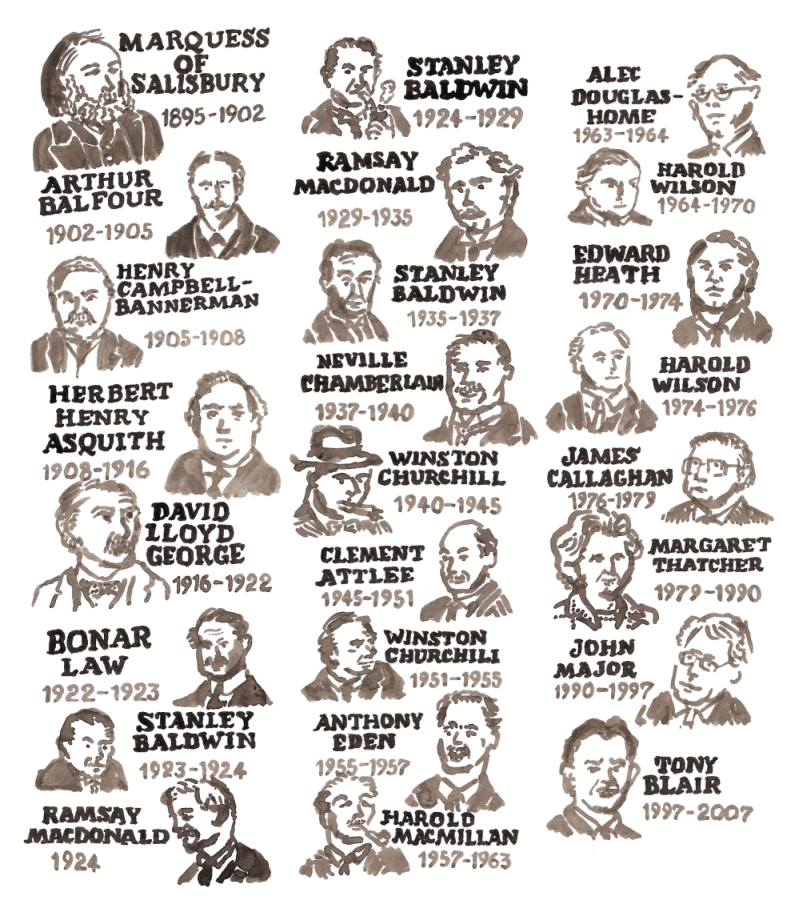
Prime Ministers

Who was Ramsay Macdonald?  When was Asquith?  What (and why) was Bonar Law?  Whenever I hear one of these names I wish I knew more about British politics of the past hundred years.

I was about to say that I don't care so much about the Nineteenth Century...  but now I sense a creeping uncertainty about Gladstone, Disraeli, Palmerston, Peel and Melbourne.

Still, for my own benefit, I've just drawn up a list of Twentieth Century prime ministers.


Sunday, 24 March 2013

College Of Arms

Hold onto your heraldic hats - it's time for a celebration of chivalry.

Last week I visited the College of Arms, in London, on an evening tour organised by the V&A.  Heraldry and calligraphy have always appealed to me, and anyone working for the College of Arms has to take pleasure in the fine rules and colourful terms.  I spent many childhood hours poring over old and older books by people with double-barrelled names, and wondered what arcane heights of gilded tradition and scholarship might be inside the College, near to St. Paul's in London.

Because I love this subject, here I shall write up most of the notes that I made.  You can find out a whole lot more at the College Of Arms website.  Here goes!


We saw three of the many rooms:  the first is open to the public every day; the second is where any appointments take place; the third is never open, being the library and archive.  There is wood panelling, flags, portraits of past heralds, and emblems and models here and there, including an elephant, a blue kiwi holding a hammer, and a black turret with a golden lion holding a lit grenade - all too large to fit on top of any knight's helmet.  Oh, and a figure of Churchill in his full regalia.

The College is technically a remote part of the royal household and the chief position, Earl Marshal, has been the Duke of Norfolk for generations.  He is the Garter King of Arms, the most important of three Kings of Arms.  Below them are six heralds and four pursuivants.  (See details at the bottom of the post).  After over five hundred years, they are still granting arms, having come into existence to record and regulate use of heraldic identities; facilitate its use for tournaments and battle; and to organise the coronation.

All of the Officers deal with clients who want to buy a coat of arms (because they are available purely for money, and not linked at all with any title or honour); carry out research work and, very occasionally, get dressed up in tabards of the royal arms to take part in the state opening of parliament and the garter procession at Windsor.  There are apprentices, artists and scriveners, and the ultimate product, for anyone buying arms, is a vellum document ("letters patent), with seals attached, describing the design in detail.  It comes rolled up in a red box with royal monograms in gold.


The first room (the one that you can see at any time) is the Earl Marshal's Court (or the Court of Chivalry), where any disputes about use of arms would be heard.  This has only happened once in well over a century.  In 1953 a case began there (before adjourning to the Royal Courts of Justice), in which the Corporation of the City of Manchester objected to the use of its arms and seal by the Manchester Palace of Varieties theatre.  This a serious business and the design (or, technically, the description) of a coat of arms is absolutely the property of a corporation or individual and their direct descendants only.
[UPDATE:  a little more on this case in another post, The High Court Of Chivalry]

The library contains armorials, books of precedence and peerage, helmets and other artifacts, archives of grants, albums of symbols and family trees in books of all sizes, hundreds of years old; some with the paint still vivid on vellum.  In the Seventeenth Century, the heralds made "visitation" to each county, to make records of people who had been using coats of arms since before the rules were introduced.  Immediately after the Civil War, Gregory King, a herald and a draughtsman, used his travels to make documentary sketches of ecclesiastical architecture, in case of further destruction.


Helmets, letters patent and the red box, an armorial and some over-sized crests. 
Plenty of individuals and organisations still want a coat of arms, a crest, a motto and so on.  The College covers all of England and Wales and much of the Commonwealth (Scotland has its own heralds), and makes 150 to 200 grants each year (it was even more popular in the 1980s).  You can have any emblem, as long as it will look good - and look good in the future.  Although there is a hefty code of design, it doesn't work in the same way as corporate design documents:  your red will just be any red that can be called red.  As long as an artist is faithful to the long description of the shield, it will be correct.  The Officers steer clients towards a lasting design, but there is room for some playful references.  The College website has a gallery of recent grants with descriptions.


I feel like I've gorged on heraldry.  There is always more to read and always someone who knows more.  It's almost a bad habit.  I hope you get sucked in too.


The Officers of the College of Arms are as follows:
Pursuivants:  Blue Mantle, Rouge Dragon, Rouge Croix and Portcullis.
Heralds:  York, Richmond, Somerset, Windsor, Lancaster and Chester.
Provincial Kings of Arms:  North and South.
Garter King of Arms.

Wednesday, 6 March 2013

Painting A Trunk

...that's what I have to do in the next few days.

Hepwrights Vintage in Bedford Place, Southampton ("One of the UK shops you NEED to know" - Glamour), needed someone to decorate a large trunk.  It's to be taken to vintage fairs, markets and other events, as an advertisement for the shop.

The proprietress has just dropped it round and now I have a week or so to cover it with information and "loveliness".

Whimsical Vintage Lifestyle!

...BUT I'm off to Manchester for the weekend, so there's a risk that the trunk will end up covered with little Lowry figures.

Wednesday, 20 February 2013

The Mayor's Parlour

Today is a big day.  I'm going to meet the mayor of Southampton and see his parlour.

I hope I'll get to see the Silver Oar of Admiralty for the first time.
There are pictures here at Town Sergeants Of Southampton.

Pictures:

  • The "mayors" section of "People of Southampton" from my degree show, last year, showing some of the list of mayors that goes back to 1217.
  • Sketches from newspaper cuttings in the city archives, featuring the three maces; one of Basil Spence's buildings for Southampton University in 1966; and photos of two kings and two queens visiting Southampton - George V and Queen Mary, and George VI and Queen Elizabeth.

I should mention The History Press's "Not A Guide To" series of little books about different towns.
"Not A Guide To Southampton" has just been published, written by a local writer, James Marsh.
It's partly personal and partly official and it's full of information that I didn't know about my home town.
I got mine at October Books.


Sunday, 27 January 2013

Class Distinctions

"Class Distinctions" is an exhibition in the Wightlink ferry terminal in Yarmouth, Isle of Wight, from 11th January to 5th April 2013, in partnership with Southampton Solent University.


That's my piece, among others from the Illustration (Becka Potter's lovely and informative "Curious Creatures"), Fine Art, Fashion Photography and Make-up And Hair Design BA courses.


You can (and should) read more at the event page from Solent University...  and there's even a tumblr for the Faculty of Creative Industries and Society.

Friday, 25 January 2013

H Is For Hunter

The Fun Times Group is a bunch of graduates from Solent Illustration, including me.  We've been working through an alphabet, picking a word each time.

It's here on Tumblr and there on Facebook.

After a long Christmas break, I've made my "Hunter" piece, which is a calling card and advertisement for an louche and enigmatic big game hunter, Hilliard Hamilton, and his emporium of goods of questionable morality.


Wednesday, 23 January 2013

Graduating

My degree course finished in June 2012, so this one is a little late.

My degree exhibition:
SOUTHAMPTON.  All of it.  Well, as much as I could fit onto three metre-wide discs of paper.
I wanted to talk about the city's architecture, development and mythology.  From the idea of a map, the project became three separate pieces:  Places, People and History.

The process involved a lot of drawing, research and photography around town, mixing standard tourist facts with little details that I remember hearing about Southampton over thirty years here.

The borders are lino-printed by hand and the rest is a jumble of ink drawings and text.  I wanted to keep it light and immediate - which is tricky when every mark is final.

To round off the display, I etched two sheets of brass with similar images, for brass-rubbing.


The show was held at Solent's new studios, which were then opened officially by Sir Peter Blake.  I met him, but had no idea what to say.  I won a prize for drawing, selected by Paul Osborne, our life drawing tutor - an astounding honour for me.

Solent Illustration had a stall at D&AD's New Blood fair at Spitalfields Market.  For me, it made up in part for our London exhibition falling through.  I was awarded one of the thirty "Best New Blood" rosettes.

Since then, my three pieces were framed; put on show in the Solent Showcase over the Summer; then bought by the university; and now are at Quay Arts, Newport, Isle Of Wight.

Meanwhile, a similar piece -  a plate design for the university - is on display at the Wightlink terminal in Yarmouth, Isle Of Wight, along with other work by graduates from Solent's creative courses.


Here are some close-ups: