Showing posts with label London. Show all posts

Monday, 27 June 2016

London Concert Halls and Theatres

My busy vignettes of London's high culture
Who doesn't like an evening out in Theatreland? Surrounded by plush velvet, tassels and gilt or in a forest of acoustically engineered shapes; flapping a glossy programme in the heat; suppressing a cough; fretting that the phone isn't turned off...

Here are the smartest and most prestigious of London's concert halls.  It's only this year that I've managed to visit them all*.  As for the theatres - well, there are scores of them and I got it down to a select ten, including the old and the new, dance and opera, west end, south bank and further afield.

These vignettes are fun to assemble and populate.  I dug deep into the oeuvre of obscure musical instruments for London Concert Halls.  For no reason other than my own initial, they all begin with C:
cittern, chitarrone, charango, clarinet, cor Anglais and crumhorn.  On Some London Theatres it's all scenery and the accessories of theatre-going.  The bust on the plinth is Garrick.

The list of venues in full:

London Concert Halls:
Barbican Centre, Royal Festival Hall, St. John's Smith Square, Cadogan Hall, Wigmore Hall, Royal Albert Hall.

Some London Theatres:
National Theatre, Almeida Theatre, Menier Chocolate Factory, Royal Opera House, Duke Of York's Theatre, Gielgud Theatre, Tricycle Theatre, Shakespeare's Globe, The Old Vic, Sadler's Wells.


* The Cadogan Hall for the Pasadena Roof Orchestra.  I became tearful when they played "A Nightingale Sang In Berkeley Square".

Wednesday, 7 May 2014

Reinstatement and Reissue

Cowering unloved behind a red curtain for the last 20 years because it went ‘out of fashion’, the mural has been quietly waiting to be brought back into school life.
There you have two familiar stories:  the neglect of decorative art in public buildings and the eventual exoneration of mid-century themes and styles.  [And there you have a fine dissertation title.]

Something sharp behind the arras:
Gordon Cullen's Greenside Mural.
This Saturday, 10th May, at at Greenside Primary School, London, Gordon Cullen's restored 1952 mural for the school will be celebrated.  The attendant festivities include a film about the mural; maypole dancing; the 20th Century Graphic Art Fair; vintage this-and-that and a new old Eric Ravilious print.  The quote above comes from the press release.  All Things Considered (St. Jude's) has a good write-up.

I didn't know about this story until recently.  The Greenside Mural Facebook page documents the gradual fundraising and restoration over the past few years.  Other murals, like Edward Bawden's at Morley College, were lost to unkind decades before the artists' reappraisal came around.  Ravilious has been gathering adoring book-buyers in the new millennium.


Nairn's London.
The other overdue celebration this weekend is that of the topographical writer Ian Nairn at the Festival Of Ideas in Bristol.  On Sunday, at The Watershed, a few of his TV films will be shown, with discussion between Owen Hatherley (of A Guide To The New Ruins Of Great Britain), John Grindrod (of Concretopia) and others.

The forgotten 1966 hit "Nairn's London" is to be reissued, following another slow-growing campaign of small voices in the wilderness.


I will be at the art fair with some of my own work (I'm still putting a bundle together), hoping to get the commemorative letterpress poster and maybe copy of Gordon Cullen's Townscape.  Here is a good guide to buying mid-century prints at Mid Century Magazine.  My partner Adam will be at the Nairn event, having campaigned for that reissue - but we'll each wish we could be at the other one too.


Finally, the winning entries for this year's Serco Prize For Illustration show a love of old transport posters and architectural guides - particularly the pieces by Eliza Southwood and Gill Bradley.

Friday, 12 July 2013

Too Many Tall Buildings

My Boris Johnson
Weathervane plan
for the Shard.
I've given some attention to tall buildings in the past few weeks and months, from serene campaniles to Sixties campuses.

Today Simon Jenkins, chairman of the National Trust, wrote in the Guardian about the colossal towers soon to spring up in developments all over London; what they will be for; who says yes or no; and why anyone wants them.  As you might guess, he is largely in the "against" position.

Here is the piece:  Who let this Gulf on Thames scar London?  Mayor Boris.

In the last decade, mayor Ken Livingstone was all about tall buildings and the futuristic lens-flare of prosperity that would bounce off their gleaming façades and all over London.  Now Jenkins is pointing the finger at Boris Johnson for opposing in principle and allowing in practice.

Otto's illustration for the Guardian. 

Jenkins writes:  "Towers imply civic leadership weak in the face of commercial pressure. They are not "vital" to the urban economy, least of all in a low-density city such as London. The last rash of speculative towers such as Centre Point in the 1970s mostly lay empty until rented for government offices. Today's are not built for people to use but as sleeping bank accounts for funk money. The Shard may well stay largely empty, like One Hyde Park and the palaces of Palm Island, Dubai. The rich may own them, but not inhabit them."

London in 2259, in Star Trek Into Darkness.

To me, the Shard, Heron Tower, the Walkie Talkie, the Cheesegrater and all the coming statements of bigness were referenced - almost satirised - in the new Star Trek, as the early phase of a monolithic sprouting all over the city (which, I admit, is hardly new).  What do you think?  Are your eyes set twinkling, or do you see a future of grand embarrassment over empty projects, or grim dystopia?

Friday, 5 July 2013

London Film & Comic Con 2013!

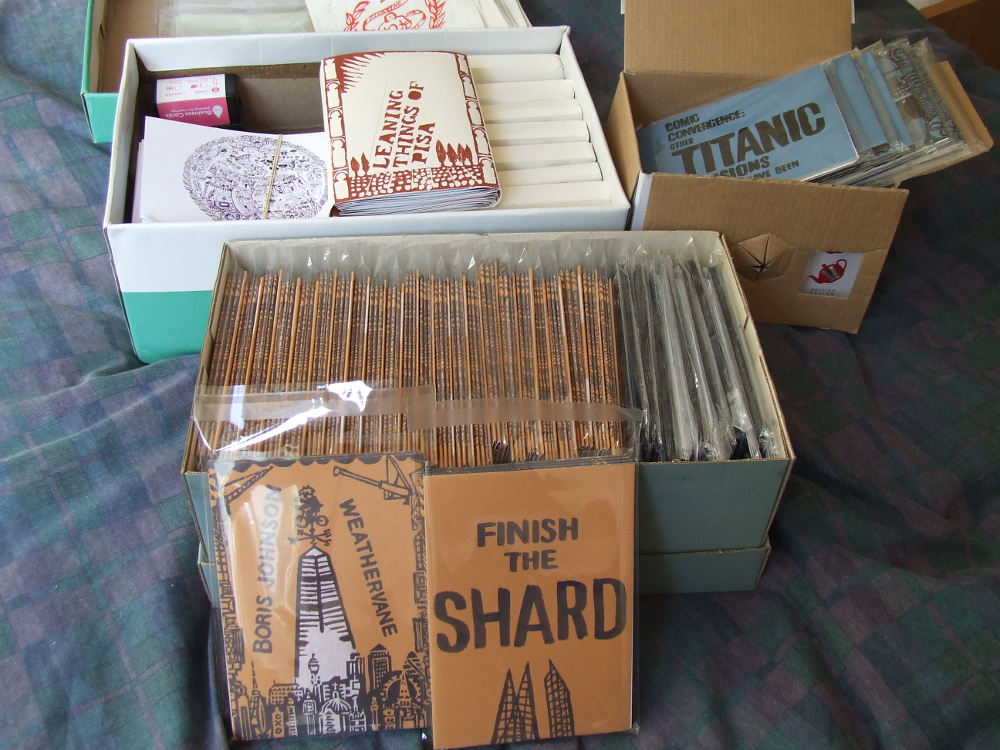
I've finally got my new booklet together!  It's about the Shard, as you might have guessed from previous posts.

Today I'm taking a bunch of them, and some of the older ones, up to LFCC at Earl's Court 2.  Somewhere among the cosplayers and comic sellers, Fun Times Group will have six stalls, between over twenty of us.

My boxes of booklets for LFCC.
It's on throughout Saturday and Sunday, and we're setting up this afternoon, in time for the preview evening.

I'm not sure what to expect - either of the LFCC world, or of my tolerance for it.  Our stalls might be like nothing else there.  We have large prints, brooches and jewellery, posters and booklets.  Come and find us!

The Shard books are finished - the Shard isn't.

Thursday, 27 June 2013

More Tall Buildings

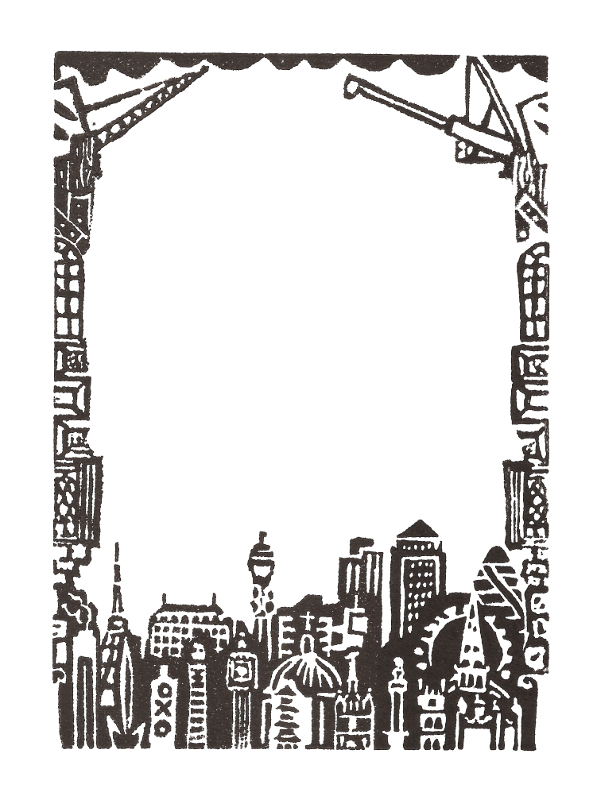
A quick update, because...  look what I found in the Empire Youth Annual 1948 (which I found on a wall nearby)!  It's rather similar to the linocut border that I've been making, showing a rough chronology of London's taller buildings.

The Empire Youth Annual 1948!
My linocut border from this week.


Friday, 21 June 2013

One Tall Building In London

Since you asked...  how many of these can you identify?

No, it's not that London shot from Star Trek Into Darkness.


Thursday, 20 June 2013

Tall Buildings In London

Fresh from my workings for an upcoming project...  how many of these can you identify?

London's big buildings

Tuesday, 18 June 2013

East Anglia 2

Here are a few drawings from the trip to East Anglia.  The plans (mentioned last week) changed somewhat:  the Beccles / Saxmundham / Aldeburgh day became Cambridge; the Winterton / Cromer day became Bury St. Edmunds.  Both were my first visit, and there was more to see in Great Yarmouth.

A group of us visited Eltham Palace, outside London, for its odd mixture of Tudor and Art Deco.  I hadn't noticed Gilbert Ledward's 1930s stone carvings set above the porch, representing mountain climbing, sports, gardening and seafaring.

Drawings from Cambridge, Bury St. Edmunds, Great Yarmouth and London.

In Cambridge the exams were ending.  We saw students soaking each other with champagne and later heading out to dinners in matching jackets.  I was sitting on a shaded bank, drawing King's College Chapel and the tops of punting poles, when I heard a soft American voice saying "Don't move an inch...":  she wanted to photograph the artist for her daughter's "Anglophile scrapbook".

Cambridge:  one of the rooms in the Museum of Archaeology and Anthropology.

Great Yarmouth's characteristic layout, scores of long, narrow, parallel alleyways ("rows") leading away from the quay, is still partially intact.  In the aftermath of heavy wartime bombing, many features dating back to the 17th Century were found hidden behind later walls.  A lot of the material was gathered together in a few semi-restored Row Houses.  It's a surprisingly large collection with a lot to enjoy, from elaborate plaster ceilings to hard-hat cellars.  The attendant dashed through after us to hang out the authentic washing on the line in the yard.

Great Yarmouth Row Houses:  the inside is all like this.

Sadly, the Olympia Cafeteria is no more.  It was a palace of pink and yellow plastic on Marine Parade with every kind of lowbrow seaside food.  Its navy-and-brown replacement might be just the same but I just don't want to find out.  We went to Las Palmas Cafeteria instead.

Tuesday, 11 June 2013

East Anglia

The forest of times and station codes.
That's where I'm heading for a few days.

It's a complicated, finely-planned trip, with some time in London on the way.  There will be many trains and I'll see some place I've never visited - ie. any of Suffolk - mostly on flying visits:  Lowestoft, Saxmundham, Beccles and Aldeburgh, where the festival is in full swing.

Let's hope I get some good drawing done.


Monday, 19 March 2012

Paul Bommer

It's a while now since I last made pilgrimage to the capital from the provinces (well, Hampshire).

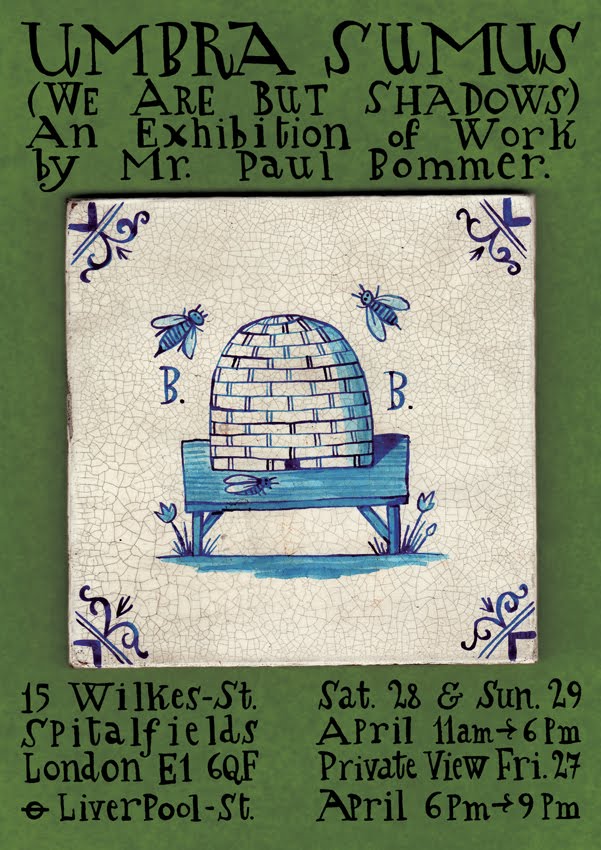
One upcoming reason to make a trip is the  "Umbra Sumus (We Are But Shadows)" exhibition by the rather exemplary illustrator Paul Bommer.  He's one of those artists who is working with a set of inspirations, methods and humour that I share and wish I could do so well; and he seems to churn out the fun "Twitter Ye May" series at an impressive pace.

It's on at 15 Wilkes St, Spitalfields on 28th and 29th April.

Another "he's everything I want to be" figure is Adam Dant, who lectured at Solent last Friday, and whose advice I'm trying to capitalise on for my degree show.

Also in April, the Comica Festival, featuring Tom Gauld and numerous others, is worth a visit - with a group of graduates, I hope.  What's more, my degree show will be in the East Gallery, Brick Lane, in July.  Back to it!

Wednesday, 22 December 2010

The Museum Of Everything

This is another temporary exhibition built out of Peter Blake's amassed ephemera of British culture over the past couple of hundred years. A lot of it is concerned with circuses, fairs and freakshows; and outsider art from shell artists to taxidermy (Walter Potter), tapestry (Ted Willcox) and Cheeta The Chimpanzee, the first non-human to exhibit in the National Gallery.

There were a lot of signs against photography. I made notes and drew, but the prohibition is a good reminder to take everything in in the time spent there, and to treat the whole thing as it was intended: not as a taxonomy of old-fashioned crafts, but a huge three-dimensional collage.

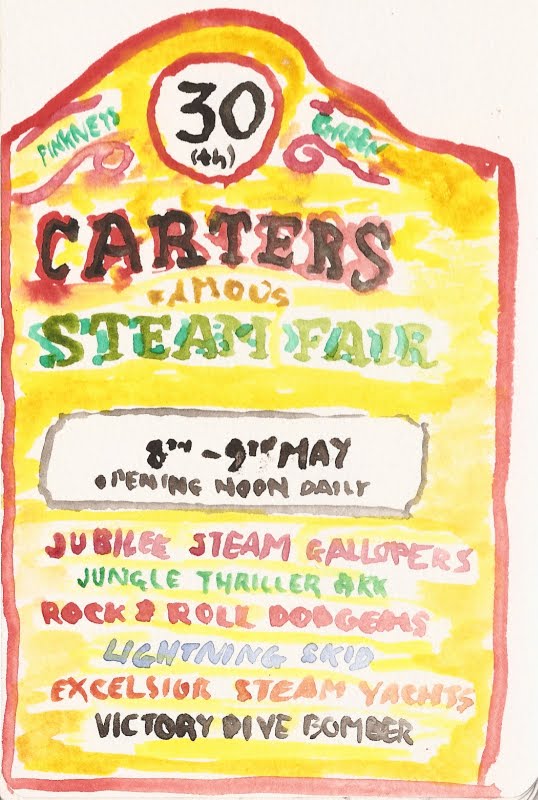
Carters Steam Fair looks like immense fun - and I've just found that it's still running!, complete with a wall of death.
Jubilee Steam Gallopers!
Jungle Thriller Ark!
Rock & Roll Dodgems!
Lightning Skid!
Excelsior Steam Yachts!
Victory Dive Bomber!

Monday, 15 November 2010

Saturday

To the Natural History Museum to revisit the hall of minerals because I was reminded by the work by Boredom Research at Millais Off-Site Projects in Southampton.


Next to the V&A to make a survey of the ironwork for reference.


Then I realised: I'd photographed agate followed by a gate.

Sunday, 14 November 2010

Wednesday, 10 November 2010

Evening At St Jude's

Angie Lewin's "Thames Fireworks" linocut.

St Jude's is a gallery in Norfolk that brings together a number of contemporary printmakers. From time to time they exhibit in London under the name St Jude's In The City.

The current show is on for a couple of weeks at Bankside Gallery. Last night was the opening night and I tagged along because two of my tutors have work on display: Charles Shearer and Jonny Hannah. It was a real pleasure to meet some of the artists and find approaches in common with other people from the illustration / printmaking world.

I particularly liked the pieces by Ed Kluz, Alice Stevenson and James Brown.


That's the view from outside, on the south bank, without fireworks.

Sunday, 26 September 2010

London Lives


London Lives

Bankside Gallery, 9th to 19th September 2010

Bankside is a contrast to the grand galleries. Instead of season-long tableaux of artistic titans, Bankside puts on short exhibitions that show the pulse of creativity. The gallery is a platform for a huge number of contemporary artists, so the displays really must change frequently. Even so, despite a run of only eleven days, London Lives, the top selection of a competition, was a dense and bristling collection of a hundred artists' submissions. That amount and wealth of work is what allows the show to represent London: a hundred aspects of the city and its surroundings. That variety allowed different media and different emphases to complement each other, capturing not only the timeless destination-views of the capital but the passing atmospheres of busy, changing streets.

London Lives.

Raphael


Raphael: Cartoons and Tapestries for the Sistine Chapel

V&A, 8th September to 17th October 2010

Only a week before the Pope's visit to London, the V&A's Raphael Court was augmented with this exhibition of tapestries commissioned for the Sistine Chapel in the Sixteenth Century.

The notes accompanying the display make the power games of the Vatican today look transparent and unbiased by comparison to the manoeuvres of the Medici. The selection of Biblical scenes for the chapel leant towards those that "reinforced the authority of the papacy" - ie. scenes of St. Peter, St. Paul and the early church.

The tapestries correspond to the cartoons (full-scale painted draughts on paper) that are on permanent display at the V&A (on loan from the royal collection after centuries at Hampton Court Palace since Charles I acquired them in Brussels before his ascension). In some places an additional painted copy is shown alongside. I found the most engaging part of the exhibition in comparing the sketches, cartoons, painted copies and interpretations by tapestry artists. Colours that work well in paint were swapped for ones that stand out better in fabric; extra space was given to craftsmen who excelled at foliage or wildlife.

The larger changes range from the theologically significant (Christ's position and gesture in "Christ's Charge To Peter") to the mildly-entertaining (on the tapestry Christ's white toga, unlike the cartoon, is covered in little golden suns). A case of sketches shows preparatory drawings of models making the same scene in everyday Renaissance dress.

Collectors in the Eighteenth and Nineteenth Centuries admired Renaissance artists' ability to "tell their story plainly". Raphael's images were revered for their "clear, dramatic narrative". The drama and dynamism are in fact souped up in the explosive stupification of onlookers at "The Death Of Ananias" and the fishermen straining at the nets in "The Miraculous Draught Of Fish".

The effect of all of this is spoiled when visitors turn to see the "Retable of St George", one of the permanent fixtures in the room: a magnificently painted and gilded altar screen demanding closer inspection. Very soon they recoil in horror when they see a few few moments of piety and triumph overwhelmed by a series of increasingly gruesome ways to die.

So, away from the subject of Raphael, here is a full list:

Retable of St George, c. 1410: altarpiece from the Chapel of the Confraternity of the Centinar de la Ploma

  • The Holy Spirit
  • Christ with the orb
  • Moses; Elijah
  • St John; St Luke; St Mark; St Matthew
  • The Virgin Mary and the Child Crowned by christ and Surrounded by Angels

  • A Christian Army under James I of Aragon Defeats the Moors with the Help of Saint George at the Battle of Puig in 1237
  • Saint George Ties the Dragon with the Princess's Girdle
  • The King, Queen, Princess and the People of Silene are Baptised
  • Saint George Denounces the Pagan gods before Dacian
  • Saint George is Tortured tied to a Cross
  • Saint George Survives Poison
  • Saint George is Tortured on a Table
  • Saint George is put in Prison
  • Saint George is Tortured between two wheels
  • Saint George is Tied between two Posts and Sawn in Half
  • Saint George is Tortured in a Cauldron
  • Saint George at Prayer
  • Saint George Fights the Dragon
  • Saint George is Dragged by Horses
  • Saint George is Beheaded

  • The Agony in the Garden
  • The Betrayal
  • Christ before Caiaphas
  • The Flagellation
  • The Mocking
  • Christ Bearing the Cross
  • The Crucifixion
  • The Deposition
  • The Entombment
  • The Resurrection
It's fascinating and it's horrible.

Wednesday, 22 September 2010

Eadweard Muybridge / Rachel Whiteread


Eadweard Muybridge


Muybridge is best known for his photographic studies of humans and animals in motion: multi-angle series of shots of, say, a woman walking down a set of steps and turning; or the image that proved that a horse can have all four hooves in the air in the course of galloping. I heard visitors announcing to each other "This is what we've come for" when they reached zoopraxiscopes and zoetropes (the contraptions that animated these series) two thirds of the way through this exhibition. Like me, they probably remember their inclusion in childhood books of experiments. Moving or 3D images are inately entrancing to us (remember the arrival of magic-eye pictures), but it is clear how, in the 1870s and 80s, Muybridge advanced cinematography, zoology and figure-drawing.

The preceding few rooms show the continuation from his ground-breaking work in photography - both the art and the technology. An Englishman in America, Muybridge (who frequently revised his name and identity) was keen to make the most of the newest arenas. His single-mindedness (which may have lead to some questionable ethical and moral choices, leaving aside the accusation of murder) and innovation are clear even today and his travels result in a document of American expansion in the second half of the 19th century, complete with Indians and Chinamen.

The daring and sometimes mind-bending views of Yosemite and San Francisco (I spent some time working out which way up the book should be, with another visitor) convey the wonder and the lure of both the American landscape and its new towns. It's not just because I've been there that these settings make the later images of Panama and Guatemala look quaint, despite their theatrical poise and precision.

Although the first few rooms hop about in the artist's chronology, they all lead up to the big draw, the high-tech experiments involving rapid-fire work with multiple cameras, prefiguring Matrix-style "bullet-time". He tried everything: analysing the movement of people with physical impairments; wrestling; splashing about in tubs of water; getting into bed and, most amusingly, a woman in a full Victorian dress and a large hat, leaping over a stool. The camera's ability to stop time and to split a subject into multiple angles (a trick replicated for visitors with a clever glass wall at the entrance and exit) proved what the eye couldn't see and still struggles to believe.


Rachel Whiteread Drawings

I can't imagine a more opposite artist to have printed on the same ticket and exhibited just through a wall or two from the Muybridge show. In the work of Rachel Whiteread it is the spaces that are captured and frozen; arenas of human activity are rendered monumentally still; busyness countered with contemplation.

Throughout this Autumn, Tate Britain hosts a fairly conventional appreciation of Eadweard Muybridge right next to this smaller (and cheaper) exhibition showing the byproducts or sideline of Whiteread's immense public sculptures: her sketches, drawings and doodles.

Some pieces show visual preoccupations that fed into full-scale work; some are simply intriguing by showing Whiteread's playful experiments with line; some show the construction behind specific works such as the Holocaust Memorial.

It's informal but technical, and accomplished despite being created without display in mind, but has no real conclusion. I'm not sure that the organisers know what to do with a collection that is neither a body of related work nor a progression of complete statements, but a scrapbook of a journey that isn't yet finished.


These two shows are running at Tate Britain from 8th September 2010 to 16th January 2011. Extra marks to the Tate for the A6 exhibition guides.


Post-script


On the subject of Yosemite, let's compare Eadweard Muybridge at Mariposa Grove in 1872 to my sister at Mariposa Grove in 1998. I've been debating whether it's the same tree.


Sunday, 6 June 2010

Polo In The Park

Today Louisa and I went to watch polo at Hurlingham Park in London. Here are a few pen sketches. I've given up on brush-pens for a little while out of frustration at endless issues with the ink-flow. One day I'll get it right. The watercolour experiments make up for that in part.


Drawing sporting activity is a challenge. I had a go at sketching karate a few weeks ago, but the polo was another thing entirely, especially as I'm new to drawing horses. Their heads come out the wrong shape. Thanks to Louisa for explaining all the bits and bridles.


There were national and international matches; displays of horsemanship (and cheerleading); fine food; fresh coconuts and Pimm's flowing like water - albeit at £7.50 per pint.


I may have found my sport to follow.

To think - until today I had never stamped a divot!

Monday, 25 May 2009

Google Thames

Google Maps showed me these aerial views of the Thames in London.

I love the shadows of the south bank skyline on the water.

Further west, the trees in Battersea Park and the power station are perfectly clear.

Wednesday, 24 December 2008

Holidays!

For the first time in a few years - and as a pleasant by-product of my studies - I have a Winter holiday.

Last week I spent a few days in ambitious artistic luxury at the V&A, drawing sculptures and photographing textiles for future inspiration.


The rest of the time I visited a variety of cafes and started my equally-ambitious reading pile from various libraries.


Now, at home with my family, my creativity has gone into Christmas preparations. I've just finished wrapping presents.